
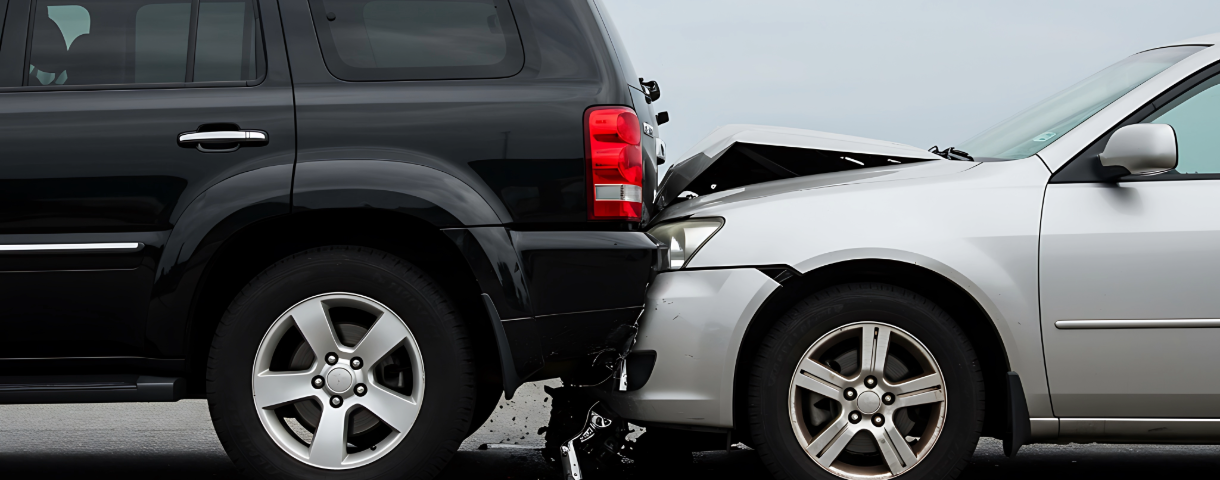
Rear-end collisions are the single most common type of motor vehicle accident in New Jersey.
Practice Area
New Jersey Rear-End Collision Lawyers
More Than Just a "Fender Bender." Protecting Your Spine and Your Financial Future.
Rear-end collisions are the single most common type of motor vehicle accident in New Jersey.
- No Fee Unless We Win
- Free Case Review
- Trial-Ready Attorneys
- New Jersey Focused

Rear-end collisions are the single most common type of motor vehicle accident in New Jersey. Whether you are caught in brutal, stop-and-go commuter traffic on the Garden State Parkway, waiting at a red light on Route 1, or slowing down for a toll booth on the Turnpike, you are constantly vulnerable to the drivers behind you.
Because these accidents happen so frequently, the insurance companies have developed a deeply ingrained, highly profitable strategy for dealing with them: they systematically dismiss rear-end crashes as "minor fender benders." They will look at a scuffed rear bumper, classify the impact as a "low-speed event," and offer you a few hundred dollars to sign away your rights.
Do not let an insurance adjuster gaslight you. Even at relatively low speeds, the violent, whipping motion of a rear-end collision transfers massive kinetic energy directly through your vehicle's frame and into your spine. What the insurance company calls a "minor soft tissue strain" is often a debilitating, permanent spinal injury that will alter the rest of your life. At Pinnacle Injury Law, we do not let insurance corporations dictate your medical reality. We are elite trial attorneys who understand the devastating physics of rear-end crashes, and we fight aggressively to secure the maximum compensation you need to heal.
When it comes to proving liability in a rear-end collision, New Jersey law provides injured plaintiffs with a significant tactical advantage. Under N.J.S.A. 39:4-89, all drivers are legally required to maintain a safe following distance that allows them to stop safely if the vehicle in front of them suddenly halts.
Because of this statute, New Jersey courts generally apply a rebuttable presumption of negligence against the driver who rear-ends another vehicle. In plain terms: the law automatically assumes the driver behind you is at fault.
However, this presumption is "rebuttable," meaning the defense will inevitably try to shift the blame to you. Their insurance lawyers will frequently argue:
"The plaintiff stopped suddenly and without warning."
"The plaintiff's brake lights were not working properly."
"A third 'phantom vehicle' cut the defendant off, forcing them to swerve and hit the plaintiff."
"The plaintiff violently 'brake-checked' the defendant."

Pinnacle Injury Law moves aggressively to shut down these defense tactics. We subpoena the at-fault driver's cell phone records to prove they were texting, not reacting to a "sudden stop." We secure dashcam footage, intersection surveillance, and the at-fault vehicle's black box (EDR) data to definitively prove they failed to brake in time because they were distracted, speeding, or following too closely.

The most aggressive tactic used by defense attorneys in rear-end cases is the "Low Property Damage" (LPD) defense. They will show the jury enlarged photographs of your car's rear bumper, pointing out that there is only a minor dent or a few scratches. They will then argue: "If the car wasn't severely damaged, how could the human inside be severely injured?"
This argument ignores basic automotive engineering and human anatomy. Modern vehicle bumpers are explicitly designed to be highly stiff and resilient in low-speed crashes to save the insurance company money on auto body repairs. Because the bumper does not crumple and absorb the kinetic energy of the crash, that violent energy has to go somewhere—so it passes straight through the chassis, through the seat, and violently into your spine and brain.
Pinnacle Injury Law partners with biomechanical engineers and accident reconstruction experts who specialize in occupant kinematics. We scientifically prove to the jury that a lack of crushed metal on the outside of the car actually results in more violent force being inflicted upon the fragile ligaments, disks, and nerves inside the car.
The term "whiplash" has been unfairly stigmatized by insurance propaganda. In reality, it is a severe medical condition known as Cervical Acceleration-Deceleration (CAD) syndrome.
When you are struck from behind, your torso is suddenly thrust forward by the seat, but your head remains momentarily in place, causing your neck to violently hyper-extend backward over the headrest. A fraction of a second later, your head snaps violently forward (hyper-flexion). This unnatural, whip-like motion causes devastating damage:
Ligament and Muscle Tearing The stabilizing soft tissues of the neck are stretched beyond their anatomical limits, causing micro-tears that lead to intense, chronic pain, stiffness, and permanent scar tissue.
Herniated and Bulging Disks The immense pressure crushes the intervertebral disks in the cervical (neck) and lumbar (lower back) spine. The disks can rupture, pressing directly onto the spinal cord or nerve roots, causing radiating pain, numbness, and weakness in the arms and legs (radiculopathy).
Traumatic Brain Iinjuries (Concussions) Your head does not actually need to strike the steering wheel to suffer a brain injury. The violent whipping motion alone causes the brain to slam against the inside of the skull (a coup-contrecoup injury), resulting in concussions, memory loss, chronic vertigo, and cognitive impairment.
Symptoms of these injuries frequently do not appear for 24 to 48 hours as adrenaline masks the pain and inflammation slowly builds.

If you selected the "Limitation on Lawsuit" (verbal threshold) on your New Jersey auto insurance policy, you face a massive hurdle in a rear-end collision case. You are barred from suing for pain and suffering unless you can prove, through objective medical evidence, that your injury is permanent and will not heal to function normally.
Insurance companies bank on defeating rear-end claims using the verbal threshold. Pinnacle Injury Law knows how to pierce it. We work directly with your neurosurgeons, orthopedic specialists, and pain management doctors to secure high-resolution MRIs, EMG nerve conduction studies, and detailed expert narrative reports. We build an ironclad medical file proving your herniated disks and permanent ligament damage easily satisfy the statutory requirements.
Do not let the insurance company process you like a number on a spreadsheet. We prepare your case to recover maximum compensation for your expensive diagnostic imaging, physical therapy, spinal injections, potential fusion surgeries, and lost earning capacity.
Protect your spine, your financial security, and your future. Contact Pinnacle Injury Law today for a free, comprehensive case evaluation. We advance all costs to build your case, and you pay us absolutely nothing unless we secure a financial recovery on your behalf.


When it comes to proving liability in a rear-end collision, New Jersey law provides injured plaintiffs with a significant tactical advantage. Under N.J.S.A.
The most aggressive tactic used by defense attorneys in rear-end cases is the "Low Property Damage" (LPD) defense. They will show the jury enlarged photographs of your car's rear bumper, pointing out that there is only a minor dent or a few scratches.
The term "whiplash" has been unfairly stigmatized by insurance propaganda. In reality, it is a severe medical condition known as Cervical Acceleration-Deceleration (CAD) syndrome.
If you selected the "Limitation on Lawsuit" (verbal threshold) on your New Jersey auto insurance policy, you face a massive hurdle in a rear-end collision case.

More Than Just a "Fender Bender." Protecting Your Spine and Your Financial Future.
If you are dealing with the aftermath described on this page, Pinnacle Injury Law can review what happened, what evidence may matter, and what next steps may be available.